

This tissue and towel producer achieved a 25% wet strength chemistry reduction with autonomous control.
Solenis OPTIX™ Applied Intelligence is our partner in bringing autonomous control to the pulp and paper industry to optimize processes and reduce waste. OPTIX is built on ProcessMiner’s platform and licensed to Solenis for pulp and paper, and this case study comes from an OPTIX deployment.
At a glance
- Company: North American tissue and towel producer
- Challenge: An inefficient wet-strength chemistry dosage scheme, managed by hand against lagging reel-to-reel quality tests
- Solution: Autonomous, closed-loop chemistry dosing with Solenis OPTIX™ Applied Intelligence
- Results over six months: 25% less wet-strength chemistry, 23% less variation in wet tensile, 63% better target adherence, and no additional off-quality production
The challenge
Tissue and towel mills live with a tradeoff that never fully resolves. They need enough chemistry to hit strength targets and no more, while raw materials drift, machine speed changes, and grades shift through the day. Overdose and you pay for chemistry and strength the customer didn’t ask for. Underdose and quality slips.
This producer wanted to cut raw material consumption while keeping wet tensile on target. Its wet-strength dosage scheme was inefficient. Quality is measured reel to reel, so operators adjusted dosage against results that lagged the process, and every shift brought its own judgment to the job. Skilled operators can manage that for a while. They can’t optimize it continuously across three shifts, and the best operator’s instincts don’t carry over to the next crew.
The mill went looking for an autonomous control solution built for the pulp and paper industry.
The solution
The mill implemented OPTIX, an AI and machine learning platform for predictive analytics with autonomous control. OPTIX generates a virtual measurement of wet tensile in real time, so the mill no longer had to wait for the next reel test to know where quality was heading. Based on that prediction, the platform adjusts wet-strength chemistry dosage to drive wet tensile to target.
The models behind it are adaptive and self-learning:
- Predictions every 30 seconds give the controller a current read on quality between lab tests.
- Models retrain with every new lab value, so they keep pace with the mill’s own data instead of going stale.
- When conditions change, such as a new raw material lot, a speed change, or a grade shift, the system adapts and stays accurate without anyone having to rebuild a model.
Control runs in a closed loop. Predictions run continuously in the background, and the system adjusts dosage when the process needs it, without a stream of alerts for operators to sort through. See how autonomous, closed-loop control works.
The results
Over six months under autonomous control, the mill cut wet-strength chemistry usage by 25%.
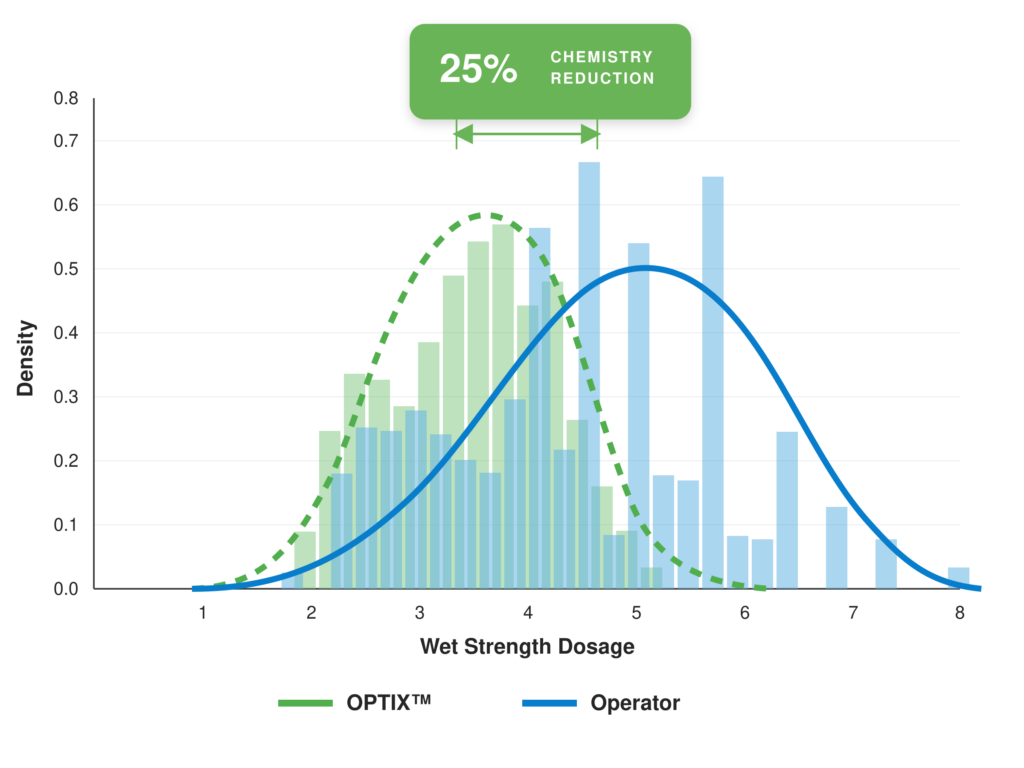
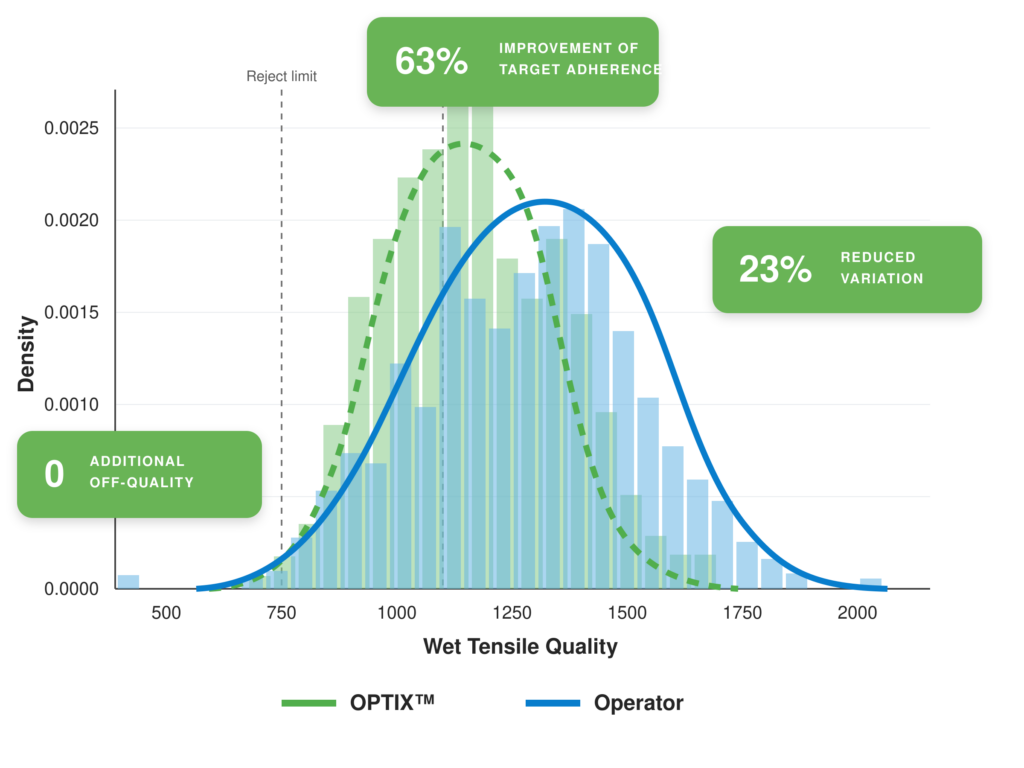
Quality improved at the same time. Under manual dosing, wet tensile ran well above target and spread wide. With OPTIX adjusting dosage toward the wet tensile target, the mill:
- Reduced wet tensile variation by 23%
- Improved target adherence by 63%
- Added no off-quality production while making the reduction
Why it worked
Most chemistry-control efforts don’t fail on day one. They fail a few weeks later, when the process moves and the model doesn’t move with it. This deployment held its savings for six months because the models kept learning: a fresh quality prediction every 30 seconds, retraining with every lab value, and adjustment as raw materials, grades, and machine conditions changed.
The charts also show where the savings came from. Operators were dosing to stay safely above spec, which meant paying for strength the product didn’t need. Holding wet tensile tighter to target let the mill take that margin out without risking off-quality.
Chemistry is one of the largest controllable costs in a tissue or paper operation. Explore the ROI case for chemistry optimization to estimate what a similar reduction could mean for your mill.
Note: This case study highlights the strategic partnership between ProcessMiner and Solenis in pulp and paper continuous manufacturing. Outside pulp and paper, ProcessMiner’s platform is available directly for other continuous manufacturing industries.